
 sales@gsl-energy.com
  0086 13923720280


ENERGY FLEXIBILITY FOR A RENEWABLE GRID
What Danish Energy Professionals Need from a BESS
For a Danish installer or project developer, the commercial case starts with the site—not the cabinet. The BESS must fit the PV profile, load curve, grid connection, electricity agreement, and control strategy. It must also arrive with clear interfaces, usable documentation, and a defined scope of supply.
Store More Solar Energy
Capture surplus daytime PV generation and use it when the facility load is higher or solar production has fallen.
Respond to Power Prices
Schedule charging and discharging around the site's electricity agreement, operating hours, and applicable market price signals.
Manage Site Power
Reduce short-duration load peaks, support EV charging and manage sites where grid capacity is constrained.
Build Energy Resilience
Combine batteries, PV, PCS, EMS and optional switching equipment for backup or microgrid operation where required.
Project economics vary by load profile, electricity contract, PV generation, grid connection, market access, operating strategy and battery degradation assumptions. GSL ENERGY sizes the system around project data rather than using a fixed payback claim.
DENMARK BESS APPLICATIONS
Match the BESS to the Customer's Use Case
Start with the customer's operating objective, then select power, capacity and controls. One site may combine several value streams, but the dispatch priorities, warranty limits and required state-of-charge reserve must be agreed during system design.
Commercial Solar Self-Consumption
Store excess rooftop or ground-mounted solar generation for later use in offices, retail facilities, hotels, warehouses and mixed-use properties.
Industrial Peak Shaving
Discharge during short load peaks and coordinate battery power with production schedules, grid import limits, and on-site generation.
Electricity Price Optimisation
Use EMS scheduling to charge and discharge according to the site's tariff structure and selected electricity market signals.
EV Charging Support
Buffer high charging demand, integrate solar power and reduce the need to design every charging event around the available grid connection.
Microgrid and Backup Power
Coordinate PV, batteries, loads and optional generators through an EMS, with STS and black-start functions selected when the project requires them.
Grid Flexibility Services
A technically suitable BESS may support reserve or flexibility services through an approved market participant, subject to prequalification and market rules.
Factory-Direct Energy Storage for Faster System Design and Quotation
GSL ENERGY provides factory-direct energy storage solutions for residential, small commercial, commercial and industrial, and multi-megawatt-hour projects.
The portfolio ranges from low-voltage stackable batteries and modular high-voltage battery systems to 261 kWh and 418 kWh liquid-cooled BESS cabinets and containerised energy storage systems.
Danish installers, system integrators, distributors, project developers and procurement teams can select suitable products based on the application, required power, storage capacity and grid connection arrangement. A broad factory-direct portfolio also helps simplify preliminary system design, technical coordination, project quotation and delivery planning.
51.2V Stackable LiFePO₄ Battery
A modular low-voltage battery platform designed for Danish solar installers serving homes, farmhouses, small offices and light commercial customers. Installers can begin with a practical battery size and add parallel units when the customer's energy demand increases.
- Suitable for mainstream compatible 48V hybrid inverters
- Modular format for easier transport, stocking, and installation
- Built-in BMS with CAN/RS485 communication on applicable models
- Useful standard product line for solar installers and distributors


GPro High-Voltage Stackable Battery
A modular high-voltage LiFePO₄ battery platform for homes, villas, farmhouses and selected small solar storage projects. Capacity can be configured from 10.24kWh to 61.44kWh per tower, with up to five systems in parallel, subject to inverter compatibility and project design.
125kW / 261kWh All-in-One Liquid-Cooled BESS
The GSL-CESS-125K261 integrates LiFePO₄ battery racks, bidirectional PCS, EMS, BMS, liquid cooling, and fire protection in one outdoor cabinet. Its approximately two-hour power-to-energy ratio is well suited to solar self-consumption, peak management, EV charging support, and flexible C&I operation.
- 125kW rated power and 261kWh energy capacity
- 832V high-voltage battery architecture
- Up to 98.6% PCS efficiency
- IP54 enclosure and -30°C to +60°C operating range
- Up to 24 systems in parallel, approximately 6.26MWh

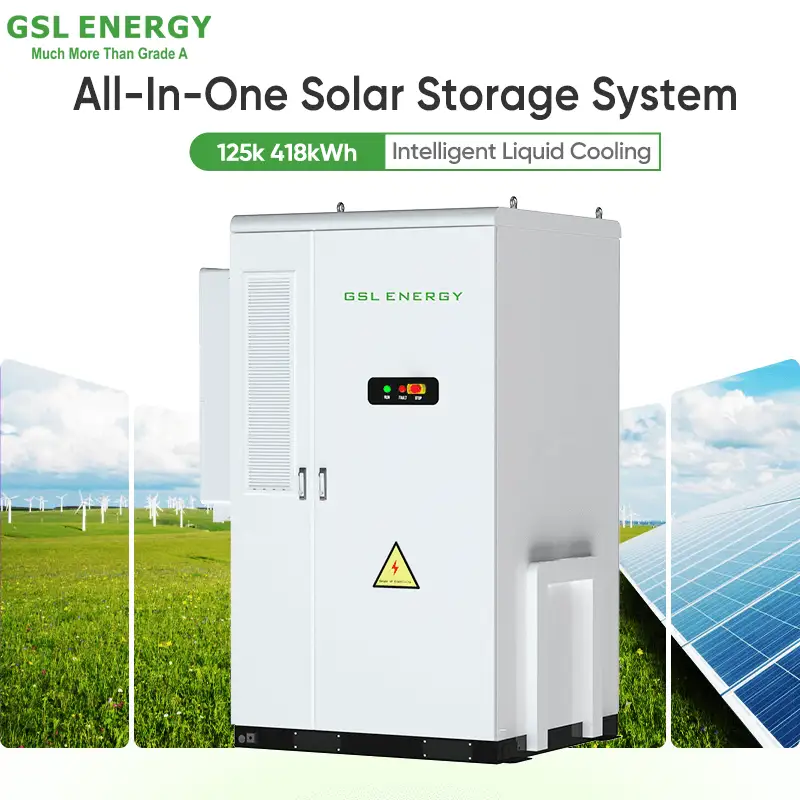
125kW / 418kWh Liquid-Cooled Solar BESS
The GSL-BESS-418K provides more energy capacity at the same 125kW rated power, making it suitable for projects that need longer discharge duration, greater daily solar shifting, or extended microgrid operation. Battery storage, power conversion, thermal management, BMS, and multi-level safety controls are coordinated as one system.
- 125kW rated output and 418kWh energy capacity
- Suitable for factories, farms, commercial sites, and solar microgrids
- Intelligent liquid cooling for more uniform cell temperature
- PV, grid-connected, and off-grid architectures available by configuration
- Compatible system design with mainstream C&I inverter platforms
1MWh–5MWh Liquid-Cooled Container BESS
For larger solar farms, industrial parks, grid-connected storage and energy development projects, GSL ENERGY provides containerised battery energy storage systems with liquid cooling, fire protection, high-voltage LFP battery racks and configurable PCS, EMS and transformer interfaces.
The final scope can include AC- or DC-coupled architecture, plant-level EMS, STS, transformer integration and communication interfaces according to the connection point and operating objective.
View Container BESS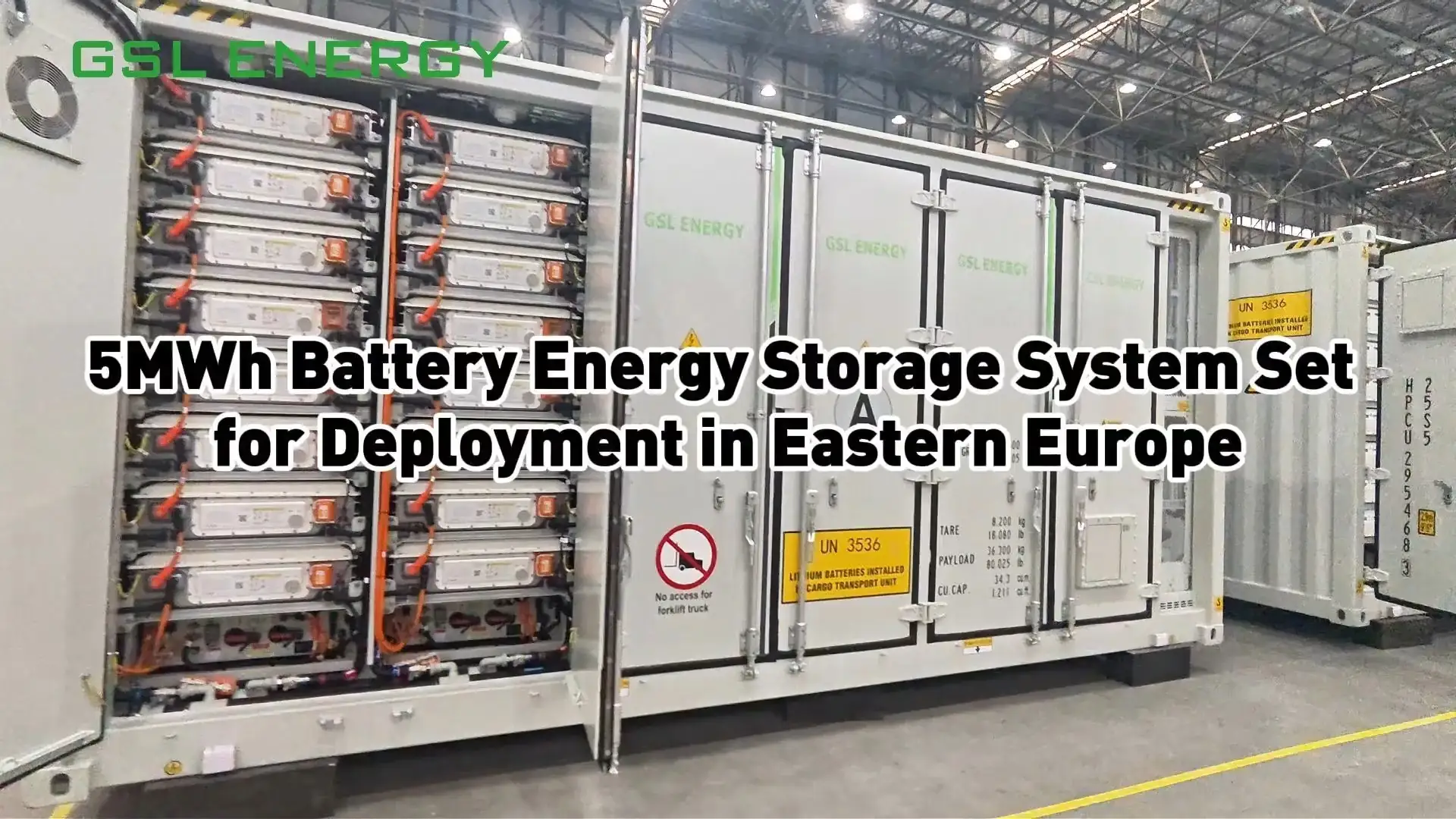
QUICK SYSTEM SELECTION
Which Battery Storage System Fits Your Project?
Use the following ranges as an initial screening guide. Final selection requires the site's interval load data, PV profile, connection limits and operating objectives.
| Typical Capacity | Recommended Platform | Typical Applications | Project Focus |
|---|---|---|---|
| 5–240kWh Battery | Low-Voltage Stackable Battery | Home, farmhouse, installer standard package | Inverter systems and flexible expansion |
| 10.24–61.44kWh HV Battery | GPro High Voltage | Home, villa, farmhouse, high-voltage solar system | High-voltage hybrid inverter architecture |
| 100kWh–300kWh Battery | 125kVa261kWh | Commercial building, factory, EV charging | Compact C&I, approximately 2-hour storage |
| 300kWh–500kWh Battery | 125kVa418kWh | Farm, industry, solar microgrid, extended backup | Longer daily energy shifting |
| 500kWh–5MWh+ Battery | Multi-Cabinet / Container BESS | Industrial park, renewable project, storage developer | Plant-level control and scalable capacity |
*Maximum low-voltage capacity depends on the selected module, BMS, inverter compatibility, and permitted parallel configuration.
PROJECT ENGINEERING
A Defined Interface between Manufacturer and Local Partner
GSL ENERGY supports equipment selection, battery and PCS coordination, EMS functions, communication interfaces, liquid cooling, fire protection and factory testing within the agreed supply scope.
The Danish installer or EPC keeps control of customer contact, site engineering, permits, civil works, local protection design, and grid-connection activities. Responsibilities can be confirmed in a project scope matrix before quotation.
SAFETY & GRID INTEGRATION
Designed for Professional European Energy Storage Projects
Available product documentation may include CE, IEC 62619, EN/IEC 62477-1, EN IEC 62933-5-2, UN38.3, and related safety or EMC documentation, depending on the selected model and project configuration.
Final Danish grid compliance depends on the selected PCS, connection voltage, protection settings, local DSO requirements, and the site-specific connection study. Certification packages should therefore be confirmed against the exact bill of materials before procurement.
MANUFACTURING & DELIVERY
Built for Long-Term Installer and EPC Cooperation
GSL ENERGY supplies the storage platform while local partners retain their project relationships and installation responsibilities. Cooperation can begin with one qualified project and expand into recurring supply, distribution, or OEM/ODM programmes.
One Technical Contact
Coordinate battery, BMS, PCS, EMS, and communication questions through one project interface.
Documents before Commitment
Review applicable datasheets, manuals, drawings and certificate scope against the selected configuration.
Partner Commercial Models
Project supply, recurring installer cooperation, distribution, and OEM/ODM options.
Factory and European Support
Factory engineering, FAT coordination and European technical resources for qualified projects.
DISTRIBUTION OPPORTUNITY
Become a GSL ENERGY Partner in Denmark
GSL ENERGY is open to cooperation with established Danish solar distributors, battery resellers, installation companies, system integrators, and C&I project partners.
The portfolio allows a local partner to serve several market segments through one supplier: low-voltage stackable batteries for repeat residential sales, GPro high-voltage systems for premium solar installations, and liquid-cooled BESS for commercial and industrial projects.
Apply for Denmark PartnershipBroad Product Coverage
Low-voltage, high-voltage, C&I cabinets and containerised BESS from one product portfolio.
Sales Enablement
Product specifications, application content, technical presentations and quotation support.
Technical Onboarding
Product training, inverter communication coordination and project configuration assistance.
Flexible Cooperation
Distributor, reseller, project supply, and OEM/ODM models assessed against the partner's capabilities.
Information for a Distribution Discussion
Please share your company profile, geographic coverage, customer segments, current solar or battery brands, installer network, expected product range, annual sales forecast, and required technical support. Territory arrangements and any exclusivity are evaluated separately based on capability, agreed targets, and market-development commitments.
HOW COOPERATION STARTS
A Practical Four-Step Project Process
Clear inputs and defined responsibilities help installers and developers move from initial enquiry to a technically aligned quotation.
Share Project Data
Location, load profile, PV size, grid limit, application and target schedule.
Confirm Architecture
Align kW, kWh, PCS, EMS, coupling method, backup scope and interfaces.
Review Offer & Documents
Check the bill of materials, datasheets, drawings, certificate scope, and delivery terms.
Factory & Delivery Support
Coordinate production, FAT, shipment, installation guidance, and commissioning scope.
FREQUENTLY ASKED QUESTIONS
BESS Denmark: Project and Purchasing FAQ
What is the best battery energy storage system for a Danish commercial project?
There is no universal configuration. A project with short demand peaks may need higher PCS power and less energy capacity, while a solar shifting or backup project may need a longer discharge duration. The 125K261 is a compact, approximately two-hour C&I platform; the 125K418 provides more energy at the same rated power for longer-duration operation.
Can a BESS store excess solar power in Denmark?
Yes. A solar battery storage system can charge when PV production exceeds on-site demand, then discharge later according to the EMS schedule. The achievable self-consumption improvement depends on the PV profile, load pattern, battery size, power rating, and operating reserve.
Can battery storage respond to hourly electricity prices?
The EMS can be configured for time-based or external-signal scheduling when supported by the selected platform. A financial assessment should consider the site's electricity contract, taxes and charges, round-trip efficiency, cycle limits and battery degradation rather than comparing spot prices alone.
Can a GSL ENERGY BESS participate in Danish ancillary services?
A technically suitable battery may participate through an approved balance-responsible party, aggregator, or other qualified market participant. Eligibility depends on the service, response performance, telemetry, metering, minimum bid rules, and successful prequalification. Market access must be confirmed with the local partner.
Can several 125K261 or 125K418 systems operate together?
Yes, multi-cabinet configurations are available. The number of cabinets, AC bus arrangement, controller hierarchy, transformer rating, protection scheme, and communication network must be engineered as one plant. The 125K261 platform supports up to 24 parallel units under the applicable system configuration.
Can the system provide backup or microgrid operation?
Backup is possible when the PCS, switchgear, STS, control logic, and grounding arrangement are designed for islanded operation. A standard grid-connected BESS does not automatically provide backup. Critical loads, starting currents, backup duration, and transition requirements must be defined before configuration.
Which information is needed to size a Denmark energy storage project?
Provide the project location, 15-minute or hourly load data, PV capacity and generation profile, grid connection limit, transformer rating, required backup loads, target operating strategy, available installation area, and preferred commissioning date. A single-line diagram is valuable when available.
Which certifications are available for European projects?
Available documentation varies by model and bill of materials. Relevant documents may include CE, IEC 62619, EN IEC 62933-5-2, EN/IEC 62477-1, UN38.3, EMC and LVD reports. Confirm the exact certification package, PCS model, and local connection requirements before placing an order.
Does GSL ENERGY work directly with Danish solar installers and EPC companies?
Yes. GSL ENERGY supports qualified installers, EPC contractors, system integrators, distributors, and project developers. Cooperation may cover a single project, recurring equipment supply, or OEM/ODM requirements. Commercial terms depend on project scope, forecast volume and support requirements.
What technical documents can a project partner request?
Depending on the product and project stage, the package may include datasheets, user manuals, communication information, outline drawings, available test reports, certificate documents and factory test records. Project-specific drawings and software interfaces should be confirmed in the quotation scope.
Is GSL ENERGY looking for battery distributors or agents in Denmark?
Yes. GSL ENERGY welcomes discussions with qualified Danish distributors, resellers, solar wholesalers, installers, and energy storage project companies. The cooperation model is selected according to the partner's sales channels, technical capability, service coverage, and expected volume.
Is an exclusive Denmark distribution agreement available?
Exclusivity is not automatic. It may be evaluated after due diligence and agreement on territory, product scope, annual targets, marketing activities, technical service capability, and performance-review terms. Non-exclusive project or reseller cooperation can normally begin with a lower commitment.
Build Your Energy Storage Business in Denmark
Send project requirements for system selection, or introduce your company to discuss distribution, reseller, agent, or recurring installer cooperation in Denmark.
Partner enquiry: Company profile · Coverage · Sales channels · Product interest · Annual forecast
Email: sales@gsl-energy.com
 Email: sales@gsl-energy.com
 Tel: +86 755 84515360
 Address: A602, Tianan Cyber Park, Huangge North Road, Longgang District, Shenzhen, China
0086 13923720280