

 0086 13923720280


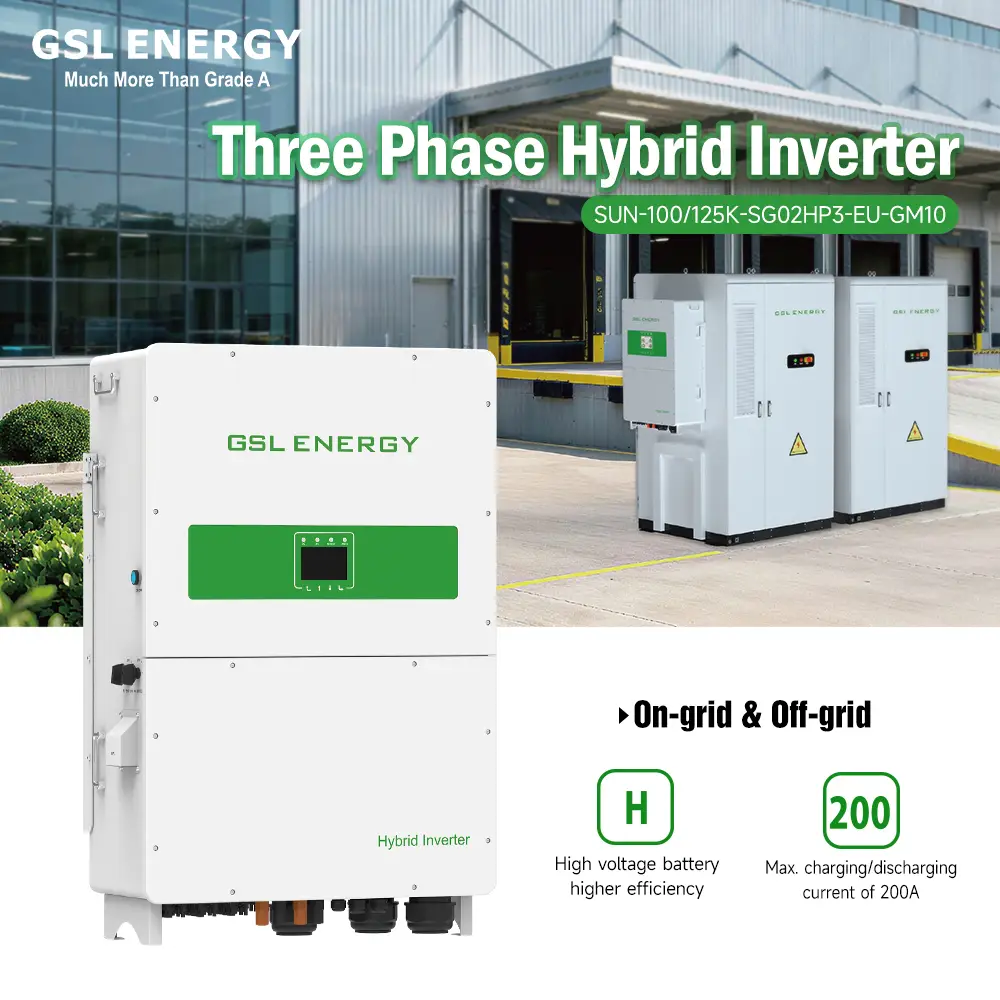
GSL ENERGY 100kW Hybrid Inverter & 125kW Hybrid Inverter | Three Phase Solar Storage
With 10 independent MPPTs, two battery inputs, and a battery voltage range of 160–1000V, the series gives system designers flexibility in PV array layout and battery configuration. Six programmable charging and discharging periods support time-based energy management, while up to 10 inverters can operate in parallel, enabling larger projects.

Key Selling Points Selling Points
100kW and 125kW options: Match inverter capacity to commercial loads and project requirements.
10 independent MPPTs: Connect PV arrays across different roof sections and orientations, with two strings per tracker.
Dual high-voltage battery inputs: Support 160–1000V lithium-ion batteries, with up to 100A charging and discharging current per input.
AC coupling capability: Add battery storage to an existing solar installation.
Up to 10 inverters in parallel: Support larger systems in both on-grid and off-grid configurations.
Six charging and discharging periods: Schedule battery operation around electricity tariffs and site demand.
Diesel generator integration: Store generator energy in compatible system configurations.
100% unbalanced output support: Accommodate unequal demand across three phases.
98.7% maximum efficiency and IP65 protection: Combine efficient power conversion with flexibility in installation location.
Technical Specifications
Compare the GSL ENERGY 100kW and 125 kW three-phase hybrid inverters for commercial solar and battery storage applications.
| Parameter | SUN-100K-SG02HP3-EU-GM10 | SUN-125K-SG02HP3-EU-GM10 |
|---|---|---|
| Battery Input Data | ||
| Battery Type | Lithium-ion | |
| Battery Voltage Range | 160–1000V | |
| Number of Battery Inputs | 2 | |
| Max. Charging Current | 100A + 100A | |
| Max. Discharging Current | 100A + 100A | |
| Lithium-ion Charging Strategy | Self-adaptation to BMS | |
| PV String Input Data | ||
| Max. PV Access Power | 200,000W | 250,000W |
| Max. PV Input Power | 160,000W | 200,000W |
| Max. PV Input Voltage | 1000V | |
| Start-up Voltage | 180V | |
| MPPT Voltage Range | 150–850V | |
| Rated PV Input Voltage | 650V | |
| Number of MPPTs / Strings per MPPT | 10 / 2 | |
| Max. Operating PV Input Current | 42A per MPPT × 10 | |
| Max. Input Short-Circuit Current | 63A per MPPT × 10 | |
| AC Input / Output Data | ||
| Rated AC Input / Output Active Power | 100,000W | 125,000W |
| Max. AC Input / Output Apparent Power | 110,000VA | 135,000VA |
| Rated AC Input / Output Current | 151.6 / 145.0A | 189.4 / 181.2A |
| Max. AC Input / Output Current | 166.7 / 159.5A | 204.6 / 195.7A |
| Max. Continuous AC Passthrough (Grid to Load) | 250A | |
| Rated Input / Output Voltage | 220/380V; 230/400V | |
| Rated Grid Frequency / Range | 50Hz / 45–55Hz; 60Hz / 55–65Hz | |
| Grid Connection | 3L + N + PE | |
| Power Factor Adjustment Range | 0.8 leading to 0.8 lagging | |
| Total Current Harmonic Distortion (THDi) | <3% at nominal power | |
| DC Injection Current | <0.5% In | |
| Efficiency | ||
| Max. Efficiency | 98.70% | |
| Euro Efficiency | 98.10% | |
| MPPT Efficiency | >99% | |
| Equipment Protection | ||
| Integrated Protection | DC reverse polarity protection; AC output overcurrent protection; thermal protection; AC output overvoltage protection; AC output short-circuit protection; DC component monitoring; anti-islanding protection; DC switch; insulation impedance detection; residual current detection. | |
| Arc Fault Circuit Interrupter (AFCI) | Optional | |
| Surge Protection | Type II (DC); Type II (AC) | |
| Display & Communication | ||
| Display | LCD + LED | |
| Communication Interfaces | RS485, RS232, CAN | |
| Monitoring Options | GPRS / Wi-Fi / Bluetooth / 4G / LAN (optional) | |
| General Data | ||
| Operating Temperature | −40°C to +60°C; derating above 45°C | |
| Permissible Ambient Humidity | 0–100% | |
| Permissible Altitude | 3000m | |
| Noise | ≤65dB(A) | |
| Ingress Protection | IP65 | |
| Inverter Topology | Non-isolated | |
| Overvoltage Category | OVC II (DC); OVC III (AC) | |
| Dimensions (W × H × D) | 734 × 1091 × 344mm, excluding connectors and brackets | |
| Cooling Method | Smart cooling | |
| Warranty | 5 years / 10 years, depending on installation location and applicable warranty policy | |
| Standards Listed in the Datasheet | ||
| Grid Regulations | IEC 61727; IEC 62116; CEI 0-21; EN 50549; NRS 097; RD 140; UNE 217002; OVE-Richtlinie R25; G99; VDE-AR-N 4105 | |
| Safety / EMC Standards | IEC/EN 61000-6-1/2/3/4; IEC/EN 62109-1; IEC/EN 62109-2 | |
Note: PV access power and PV input power are separate ratings. Battery compatibility, optional features, applicable grid requirements and warranty terms should be confirmed for the selected project.
Three-Phase Hybrid Inverter for Commercial Solar and Battery Storage
The GSL ENERGY 100kW hybrid inverter and 125kW hybrid inverter integrate solar generation, high-voltage battery storage, grid electricity and diesel generator support for commercial and industrial projects. Both models support new solar-plus-storage installations and AC-coupled upgrades to existing PV systems.
For businesses selecting a three phase solar inverter, this series combines 10 independent MPPTs, two battery inputs and programmable charging and discharging. It provides a flexible platform for managing solar production, stored energy and daily site demand.
100kW Hybrid Inverter or 125kW Hybrid Inverter?
The SUN-100K-SG02HP3-EU-GM10 delivers 100kW rated AC power, while the SUN-125K-SG02HP3-EU-GM10 delivers 125kW. Selection should follow the site's load profile, required battery power, PV array capacity and electrical connection limits.
The 100kW model supports up to 200kW PV access power and 160kW maximum PV input power. The 125kW model supports up to 250kW PV access power and 200kW maximum PV input power. These are separate ratings and should be reviewed together during PV array design.
10 MPPTs for Flexible Commercial Rooftop Design
Commercial PV arrays may cover multiple buildings, roof orientations and string layouts. Ten independent MPPTs, each supporting two strings, allow installers to group PV connections around these site conditions.
Each tracker supports up to 42A operating input current. The MPPT voltage range is 150–850V, with a maximum PV input voltage of 1000V. This gives system designers defined electrical limits for module selection and string configuration.
Dual High-Voltage Battery Inputs
This three phase hybrid inverter supports compatible lithium-ion batteries within a 160–1000V operating range. Two battery inputs each provide up to 100A charging and discharging current, for a combined maximum of 200A.
The charging strategy adapts through BMS communication. Battery selection must account for operating voltage, communication compatibility and allowable current. Available battery power depends on the actual battery voltage and the operating limits of the complete system.
Schedule Battery Operation Around Your Energy Costs
Six programmable charging and discharging periods allow battery operation to follow site demand and electricity tariffs. Operators can schedule charging during selected periods and use stored energy when it is needed.
This supports time-of-use management, solar self-consumption and planned backup reserves. Financial performance should be assessed using the site's tariff structure, interval load data, solar production and usable battery capacity.
AC Coupling for Existing Solar Installations
Businesses with an existing three-phase solar inverter can assess an AC-coupled storage retrofit. This configuration provides a route to add battery storage alongside installed PV generation.
The retrofit design should confirm compatibility with the existing PV inverter, metering arrangement, export controls and electrical protection. These checks establish how solar generation and battery storage will operate together.
Parallel Operation and Diesel Generator Integration
The series supports up to 10 inverters in parallel for supported on-grid and off-grid configurations. This allows larger commercial storage systems and microgrids to be designed around project power requirements.
Support for storing energy from a diesel generator provides another charging source for suitable projects. Parallel and generator configurations require coordinated controls, battery sizing, electrical distribution, and protection design.
Three-Phase Inverter for Mixed Commercial Loads
Factories, farms, and commercial buildings often combine three-phase equipment with single-phase lighting and appliances. Support for 100% unbalanced output helps accommodate unequal demand across phases, within the inverter's applicable phase limits.
Both models support 220/380V and 230/400V electrical systems. Maximum continuous grid-to-load AC passthrough current is 250A.
Efficient Conversion, Protection and Monitoring
The inverter provides up to 98.7% maximum efficiency, 98.1% Euro efficiency and MPPT efficiency above 99%. Its IP65 enclosure and smart cooling support suitable indoor and outdoor installations. The operating temperature range is −40°C to +60°C, with output derating above 45°C.
Protection functions include anti-islanding, DC reverse polarity protection, AC overcurrent and short-circuit protection, thermal protection, insulation monitoring and residual current detection. Type II surge protection is provided on the DC and AC sides; AFCI is optional.
An LCD and LED indicators provide local status information. RS485, RS232 and CAN interfaces support communication, with optional GPRS, Wi-Fi, Bluetooth, 4G and LAN monitoring configurations.
What Determines the 100kW Hybrid Inverter Price?
The 100kW hybrid inverter price depends on the order quantity, selected options, delivery destination and applicable warranty terms. An inverter-only quotation should be distinguished from a complete solar battery storage system quotation.
For a comparable project quotation, specify whether you require the inverter only or a package including batteries, monitoring, electrical protection and integration support. For the 125kW model, provide the same project information to compare the proposed equipment scope and capacity.
Request a Project Quotation
Contact GSL ENERGY with your installation country, grid voltage, load profile, PV capacity, battery requirements and order quantity. Our team can review the appropriate 100kW or 125kW configuration and prepare a quotation based on your project scope.
 Email: sales@gsl-energy.com
 Tel: +86 755 84515360
 Address: A602, Tianan Cyber Park, Huangge North Road, Longgang District, Shenzhen, China
0086 13923720280